Some buildings just move people from point A to point B. Others make you stop mid-stride, tilt your head back, and forget which platform you needed. The best train stations in the world do both — they’re functional transit hubs that also happen to be architectural masterpieces, time capsules, and occasionally, tourist attractions in their own right.
Here are ten stations worth the detour, chosen for the stories carved into their stone, iron, and glass.
1. Grand Central Terminal — New York City, USA
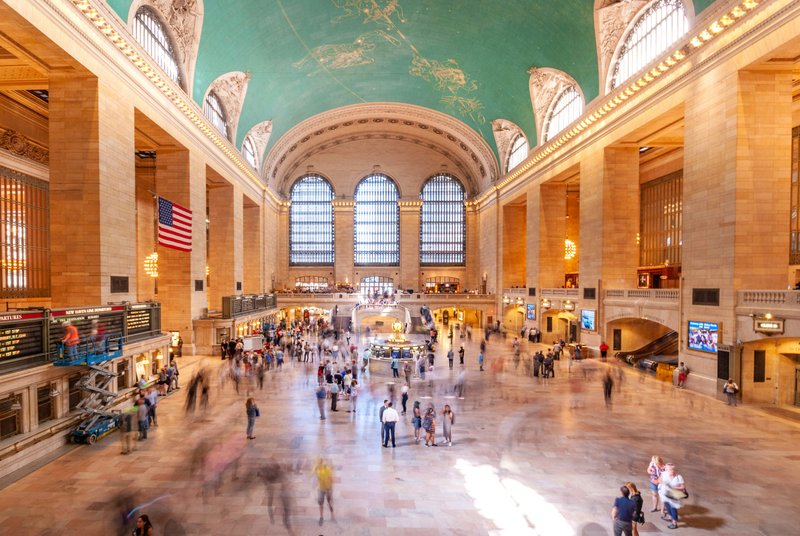
The ceiling is the headliner here. Painted a deep cerulean and scattered with a gold-leaf zodiac, the Main Concourse ceiling depicts the winter sky as seen from outside the celestial sphere — meaning the constellations are technically backwards. Nobody’s fully agreed on whether that was an artistic choice or a mistake, which only adds to the charm.
A near-miss with the wrecking ball
Grand Central almost didn’t survive the 1960s and ’70s, when a real threat of demolition loomed over the building. A preservation campaign, with Jacqueline Kennedy Onassis as one of its most visible advocates, helped push the fight to the Supreme Court, which ultimately upheld New York City’s landmark preservation law. Without that ruling, the whistling-clock information booth and whispering gallery might exist only in photographs.
2. Antwerp Central Station — Antwerp, Belgium
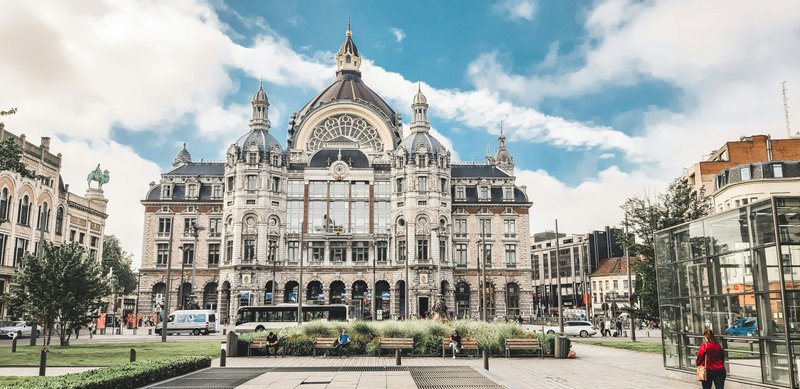
Locals sometimes call it the “Railway Cathedral,” and one look at the soaring stone entrance hall explains why. The station stacks Neo-Baroque and Neo-Gothic detailing over a dome that towers above the concourse, while underneath, the platforms descend across multiple levels connected by escalators cutting straight through the original 19th-century structure.
What makes Antwerp Central genuinely rare is that its old and new sections coexist instead of one replacing the other. The historic hall still functions as the entrance, while a modern underground expansion added platforms without erasing the original design.
3. Kanazawa Station — Kanazawa, Japan
Walk out of Kanazawa Station and you’re greeted by the Tsuzumi-mon Gate, a massive wooden torii-style structure named after a traditional Japanese hand drum, whose shape it echoes. Just beyond it sits the Motenashi Dome, a glass-and-steel canopy designed to shelter arriving visitors from rain and snow — a practical nod to the region’s notoriously wet climate.
The contrast is the point: traditional timber framing set against a contemporary glass dome, a visual handshake between old and new Japan.
4. São Bento Railway Station — Porto, Portugal
The building itself is unremarkable stone construction. The interior is anything but. The vestibule is lined with roughly 20,000 hand-painted azulejo tiles depicting scenes from Portuguese history and rural life, a project that took over a decade to complete in the early 20th century.
Tiles as historical record
Look closely and the tilework functions almost like a mural textbook — battle scenes, royal processions, and everyday transportation methods of the era are all rendered in blue and white. Commuters walk past centuries of history simply heading to catch a train.
5. Estación de Atocha — Madrid, Spain
Atocha’s original 19th-century iron-and-glass train shed was preserved even after a new station was built alongside it. Rather than demolish the historic hall, planners converted it into an indoor tropical garden, complete with palm trees, turtles living in a central pond, and walking paths winding beneath the old iron ribs.
It’s an unusual solution to an old problem: what do you do with a beautiful but obsolete structure? Atocha’s answer was to turn it into a greenhouse instead of a museum piece, keeping it alive as a space people actually walk through every day.
6. St. Pancras International — London, England
St. Pancras wears its Victorian Gothic Revival architecture proudly, all red brick and pointed arches, fronted by the former Midland Grand Hotel. Inside, the train shed’s original wrought-iron arch was, for a long stretch after its construction, one of the widest single-span structures of its kind.
From near-demolition to Eurostar terminus
Like Grand Central, St. Pancras faced serious demolition threats in the mid-20th century before preservation efforts won out. Poet John Betjeman was among the most vocal campaigners to save it, and a statue of him now stands on the concourse — a fitting tribute, given the station’s second life as the London terminus for Eurostar services to continental Europe.
7. Kuala Lumpur Railway Station — Kuala Lumpur, Malaysia
Domes, minarets, arches, and scalloped edges give this station a distinctly Moorish Revival silhouette that stands out sharply from the glass towers surrounding it. Built during the British colonial period, the design borrowed heavily from Mughal and Islamic architectural traditions rather than typical European rail-station templates of the time.
The result looks more like a palace than a transit hub, and it remains one of the most photographed buildings in the city, even though most rail traffic has shifted to newer, more central stations nearby.
8. Milano Centrale — Milan, Italy
Everything about Milano Centrale is oversized. The building spans a huge footprint, and its facade mixes Liberty style (the Italian take on Art Nouveau) with Art Deco flourishes and heavy touches of Fascist-era monumentalism, since the final version was completed during Mussolini’s rule in the 1930s.
Stone eagles and stern statues
Look up at the arches and you’ll spot carved eagles, horses, and allegorical figures meant to project power and permanence. The station was designed to impress arriving visitors before they’d even left the platform, and even now, the scale can feel almost theatrical against the everyday bustle of commuters underneath.
9. Chhatrapati Shivaji Maharaj Terminus — Mumbai, India
Formerly known as Victoria Terminus, this station blends Victorian Gothic Revival architecture with traditional Indian design elements, resulting in a hybrid style sometimes called Indo-Saracenic. Turrets, pointed arches, and a large central dome sit above stone carvings of peacocks, gargoyles, and native flora.
It’s a UNESCO World Heritage Site and remains one of the busiest train stations in India, meaning the ornate exterior is a daily backdrop for an enormous volume of commuter traffic rather than a preserved-in-amber museum piece.
10. Gare de Lyon — Paris, France
The clock tower alone makes Gare de Lyon recognizable from across the city, but the real draw is upstairs. Le Train Bleu, an ornate restaurant inside the station, has operated since the early 1900s, its ceilings covered in painted murals of destinations once served by the famous overnight train it’s named after.
Diners eat beneath gilded frescoes while commuters rush through the concourse below — a reminder that this station was built in an era when train travel itself was considered glamorous, worth marking with chandeliers rather than fluorescent lighting.
Final Stop
These ten stations prove that infrastructure doesn’t have to be purely functional. Whether shaped by preservation battles, colonial history, or sheer architectural ambition, each one turned a simple transit stop into something worth traveling for on its own. Next time a layover puts you in one of these cities, it might be worth arriving a little early.